Maybe We’re All Major Nelson Now: AI, Human Superpowers, and the Rise of the Superworker

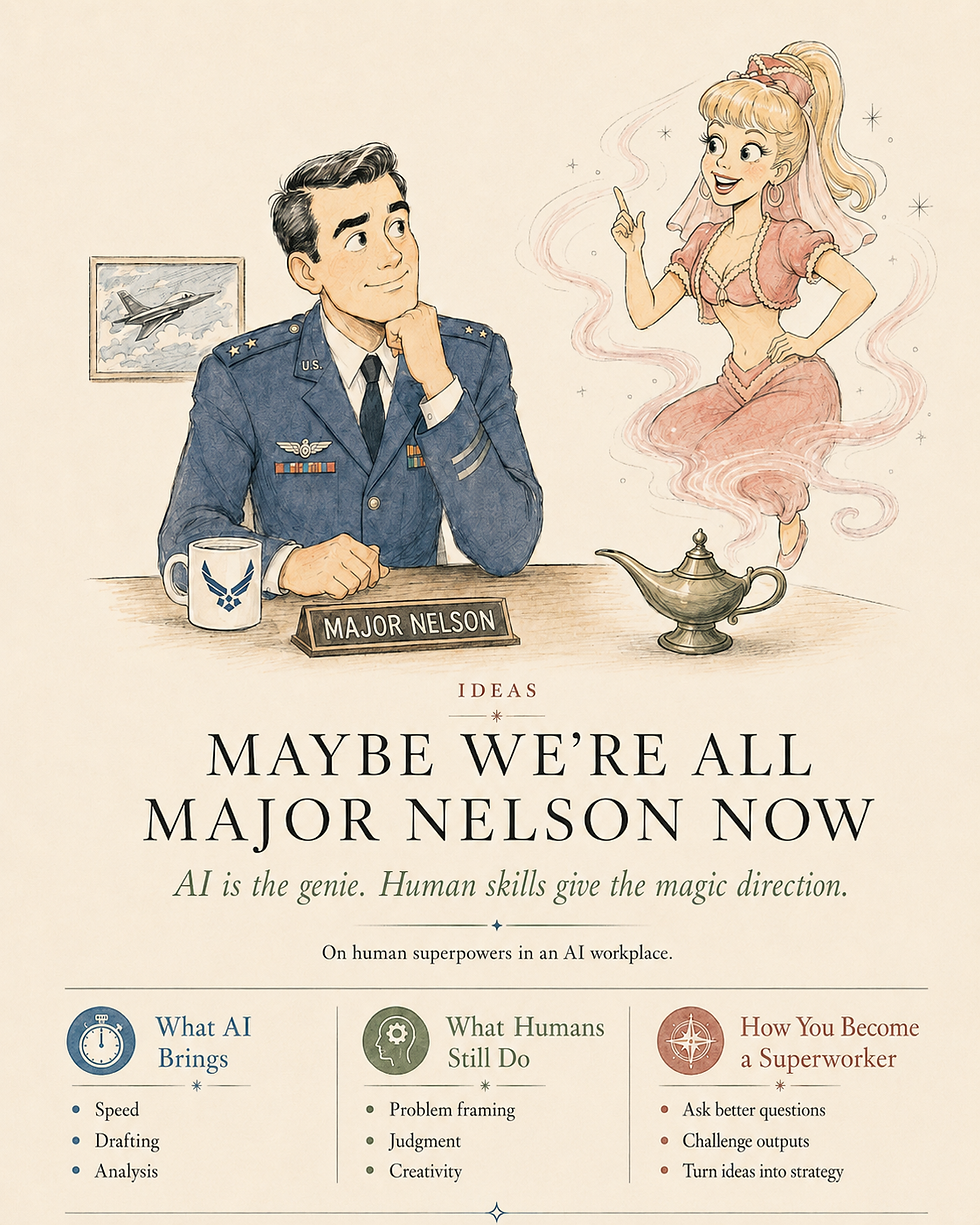
AI is Jeannie in the bottle.
Powerful. Fast. Dazzling. Occasionally useful in ways that feel like actual magic.
Also fully capable of creating twelve new problems while solving the one you asked for.
That may be the most accurate workplace metaphor we have right now. In I Dream of Jeannie, the chaos didn’t come from a lack of power. Jeannie had plenty of power. That was the point. The problem was that power without context, direction, and judgment could spin into something absurd very quickly.
That feels familiar.
Generative AI can draft, summarize, analyze, code, sort, translate, brainstorm, organize, and generate a polished response before most people have finished reading the original request.
Very magical.
Very dangerous.
Because AI can make weak thinking look finished.
It can make a vague idea sound strategic. It can make a bad question produce a confident answer. It can make a shallow training request look like a complete learning solution, even when nothing meaningful has actually changed for the learner.
That is where the human superpower comes in.
AI Is Not the Superpower. Direction Is.
The Harvard Business Review article “How GenAI Could Transform Learning and Development” makes a point that should matter deeply to anyone in workplace learning: as generative AI becomes more embedded in work, human skills become more important, not less.
The article points to problem framing, collaboration, and creativity as essential skills for working effectively with AI.
That matters because these are not decorative traits. They are not soft in the “nice to have” sense.
They are the difference between useful work and polished chaos.
Problem framing tells AI what problem is actually worth solving.
Collaboration brings in the human context that AI cannot fully understand.
Creativity turns output into something meaningful, usable, and connected to a real purpose.
Without those skills, AI becomes Jeannie blinking in every direction at once. Impressive. Fast. Sparkly. Completely capable of missing the point while looking fabulous.
Or, to put it another way, someone still has to decide whether the “perfect” output is actually useful, ethical, accurate, or just confidently wearing chaotic couture at the Met Gala.
The Rise of the Superworker Is Really the Rise of Better Human Judgment
Josh Bersin’s “superworker” framing is useful here.
The superworker is not someone who simply uses AI more often. That would make anyone with a chatbot tab open a workplace superhero, which is generous at best.
A superworker is someone who uses AI to expand what they can do. They automate routine work, speed up research, generate options, test ideas, and move faster through the mechanical parts of work.
But the real value is not speed alone.
Speed without judgment is just a faster mess.
The superworker becomes powerful because they know what to ask, what to ignore, what to revise, what to challenge, and what to turn into action.
That is the part Learning and Development needs to pay attention to.
We do not need to train people only to use AI tools. Tool training matters, but it is not enough.
We need to train people to think with AI.
That means helping employees learn how to:
Frame better questions
Define the real business problem
Spot weak or generic outputs
Challenge confident inaccuracies
Collaborate around AI-generated ideas
Use ethical judgment
Connect outputs to strategy
Turn information into action
That is where the future of workplace learning gets interesting.
Not because AI makes learning smaller.
Because AI makes the human part bigger.
The Content Factory Is Not Enough Anymore
For years, L&D has been pushed into the content factory.
Build the module. Make the deck. Create the job aid. Record the video. Push the course. Track completions. Pretend that finishing the thing means learning happened.
But content is not learning.
A course is not capability.
A completion report is not behavior change.
AI is going to make this distinction impossible to ignore because it can generate content at a speed humans cannot match. If the value of L&D is only “we make content,” then AI will absolutely look like a threat.
But if the value of L&D is helping people think, decide, practice, apply, collaborate, and improve performance, then AI becomes something else.
It becomes leverage.
AI can help create drafts, scenarios, examples, coaching prompts, adaptive practice, knowledge checks, and role-specific feedback. But the learning designer still has to decide what matters.
What should the learner be able to do?
What problem are we solving?
Where does performance break down?
What context changes the answer?
What practice actually builds capability?
Where does the learner need judgment, not just information?
That is the work.
That has always been the work.
AI just strips away the illusion that content alone was enough.
Human Skills Are Not Soft. They Are Structural.
Calling problem framing, collaboration, creativity, empathy, and judgment “soft skills” undersells them.
There is nothing soft about making a good decision when the answer is ambiguous.
There is nothing soft about communicating across departments with competing priorities.
There is nothing soft about understanding the human consequences of a technical choice.
There is nothing soft about knowing when an AI-generated answer sounds right but is still wrong.
These skills are structural. They hold the work together.
The World Economic Forum’s Future of Jobs Report 2025 also points in this direction. It identifies AI and big data as major growing skill areas, but it also highlights analytical thinking, creative thinking, resilience, flexibility, curiosity, lifelong learning, leadership, and social influence.
That combination matters.
The future worker is not purely technical.
The future worker is adaptive.
They can use technology, but they can also interpret it. They can move fast, but they can also slow down when judgment matters. They can generate ideas, but they can also decide which ideas are worth pursuing.
That is the actual superpower.
What This Means for Learning and Development
If AI is the genie, then L&D cannot just teach people where the bottle is.
We have to teach them how to make better wishes.
That means learning experiences need to shift from information delivery to capability building.
Instead of only asking, “What content do employees need?” we should be asking:
What decisions do they need to make?
What mistakes are they likely to make with AI?
What judgment calls will matter most?
What does good problem framing look like in this role?
Where do they need collaboration, not just automation?
How will they know when an AI output is useful?
How will they know when it is just confident nonsense?
This is where scenario-based learning, reflective practice, branching decisions, peer discussion, coaching, simulations, and applied projects become more valuable.
AI can help us build those experiences faster.
But humans still have to design the thinking.
The Workplace Does Not Need More Magic. It Needs Better Direction.
The magic is already out of the bottle.
That part is done.
AI is here, and it is not going back in just because someone in a quarterly meeting says “governance framework” seven times.
The real question is not whether people will use AI.
They will.
The question is whether they will use it with enough judgment to make the work better.
That is where the superworker idea becomes useful. The superworker is not a robot-assisted employee who simply produces more stuff. The superworker is someone who combines AI fluency with human depth.
They know how to ask better questions.
They know how to collaborate around messy problems.
They know how to bring context into the work.
They know how to turn output into strategy.
They know when the genie is helping.
And they know when the genie is about to redecorate the living room with a camel, a fog machine, and a legal problem.
Final Thought
AI can generate.
Humans still have to direct.
That is the future of work in one sentence.
The companies that understand this will not treat AI training as a software rollout.
They will treat it as a human capability strategy.
Because the goal is not to create more content.
The goal is to build better thinkers.
And if we do that well, the rise of AI will not make humans smaller.
It may finally force us to get serious about what makes human work valuable in the first place.
Sources
Harvard Business Review: “How GenAI Could Transform Learning and Development”Josh Bersin: “The Rise of the Superworker: Delivering On The Promise Of AI”World Economic Forum: “Future of Jobs Report 2025”BCG Henderson Institute: “How Gen AI Could Transform Learning and Development”

Comments