The Compliance Zombie and the Illusion of Interaction

There is a specific type of fatigue that only exists in corporate training. It’s the "Next-Button Trance." It happens somewhere around slide 14, right between the updated fire safety protocols and the new policy on shared refrigerator etiquette.
The learner stops reading. They stop processing. They enter a rhythmic, Pavlovian state where they wait for the "Next" button to turn blue, click it, and repeat until they reach the quiz—which they will then guess their way through using basic logic and a prayer.
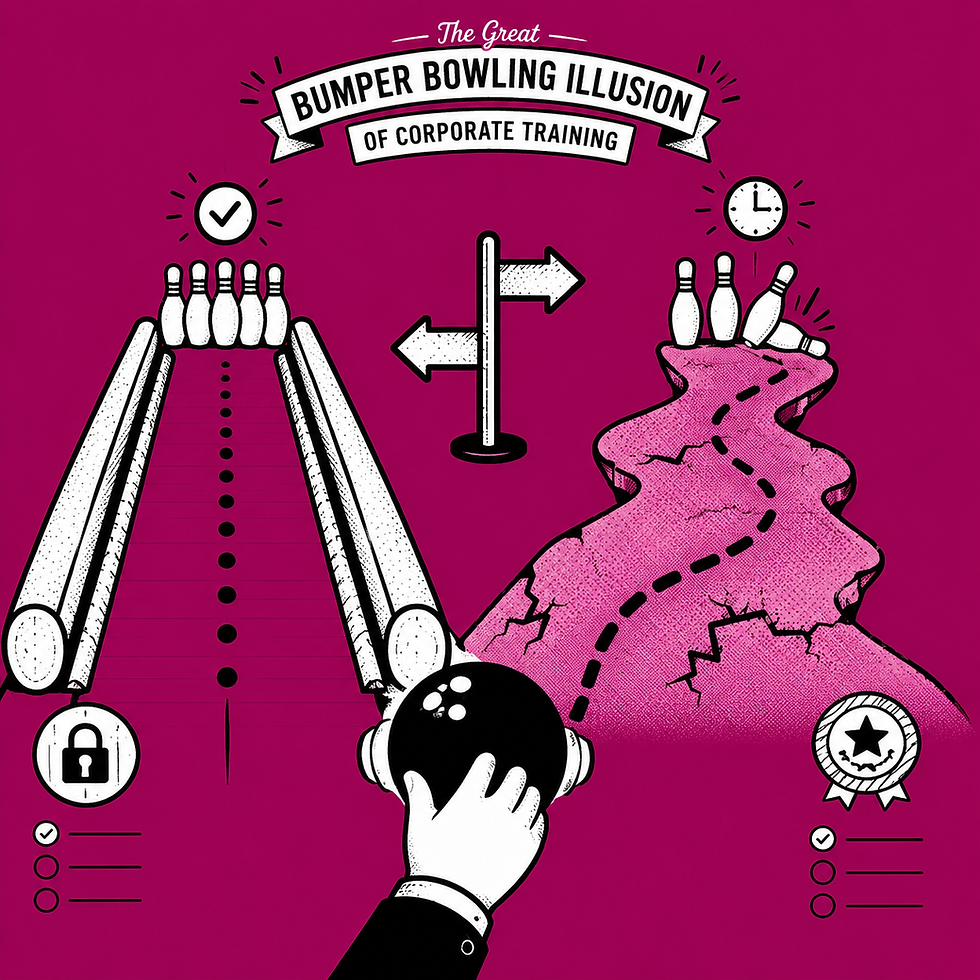
The Steering Wheel Analogy We like to call this "Active Learning" because the user is technically doing something. But let's be honest: giving a learner a "Next" button is like letting a toddler hold a toy steering wheel in the backseat of a car. It makes a clicking noise, it moves back and forth, but it has absolutely no impact on the direction of the vehicle.
The learner knows they aren't in control. And when the human brain realizes it has no agency, it stops wasting energy on attention.
The Science of Autonomy According to Self-Determination Theory (Deci & Ryan), one of the three pillars of human motivation is Autonomy. In an educational context, this means the learner needs to feel that their actions have a meaningful effect on the outcome.
When we "lock" a course or force a linear path with a single "Next" button, we are effectively telling the learner's brain: "Your judgment is not required here. Just stay awake until the end." This triggers a massive drop in engagement because the brain is optimized to ignore information that it doesn't have to interact with.
The Functional Solution: Active Sorting To break the trance, you have to introduce a fork in the road. You have to give the steering wheel back to the driver.
This is the philosophy behind the Swipe Decision Generator. Instead of a "Next" button that requires zero thought, the learner is presented with a series of quick-fire scenarios. They have to evaluate each one and "swipe" it into a category.
Is this a security risk or a standard procedure?
Is this a coaching moment or a disciplinary one?
By forcing a binary choice, you bypass the "hibernation" mode and force the brain to re-engage with the content. You aren't just moving them through a deck; you’re asking them to exercise their judgment. And in the end, isn't that what we're actually trying to train?

Comments